
Why Big Screens Feel Different
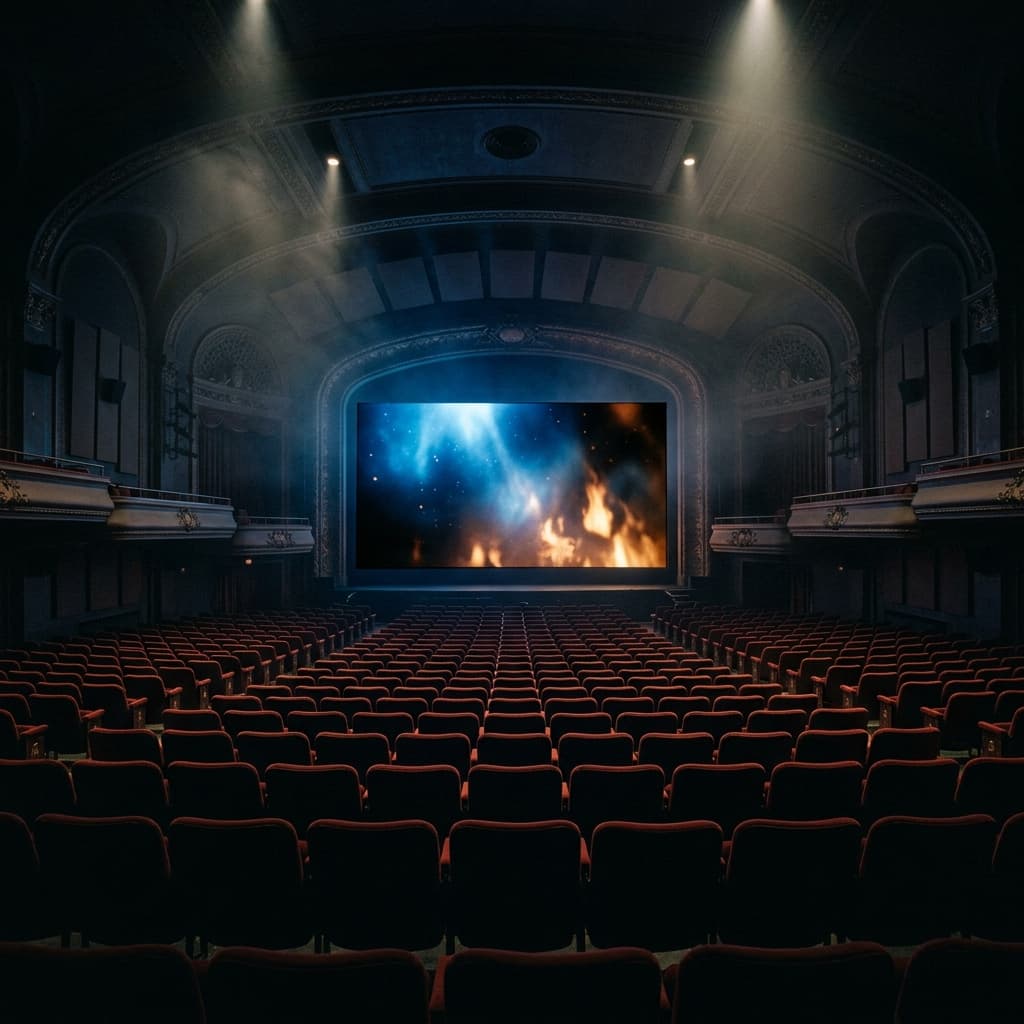
You know the feeling: the lights dim, the screen fills your vision, and the outside world vanishes. That is not just atmosphere. It is your brain responding to a carefully engineered set of sensory conditions. A cinema screen does not just show a movie: it changes how your brain processes the movie.
Research in perceptual psychology and neuroscience explains why the same film feels more exciting, more emotional, and more memorable in a cinema than on a laptop. The answer comes down to four factors: peripheral engagement, attentional capture, emotional amplification, and shared arousal.
Peripheral Engagement: Tricking Your Brain Into "Being There"
Human peripheral vision is not for reading or recognising faces. It evolved to detect motion and assess the environment. When a cinema screen fills 40-70 degrees of your horizontal field of view (as recommended by THX and SMPTE standards), it spills into your peripheral vision. Your brain interprets this as being inside the scene rather than watching it through a window.
This is why IMAX feels so immersive: its tall, curved screen pushes well past 60 degrees, engaging peripheral vision from all directions. It is also why the front row feels overwhelming rather than immersive, the screen overruns peripheral vision so aggressively that it triggers disorientation.
Attentional Capture: The Dark Room Effect
A cinema screen is the only bright surface in a completely dark room. Your visual system has no choice but to lock onto it. This is involuntary attentional capture, the same mechanism that makes you notice a flickering light in the dark.
At home, your peripheral vision picks up the lamp, the bookshelf, your phone screen. Each one pulls a tiny bit of attention. In a cinema, those distractions are eliminated. Your brain allocates nearly all of its visual processing bandwidth to the movie. The result: you notice more detail, absorb more story, and remember more afterwards.
This is partly why theaters still beat home setups even when the TV is technically sharp enough. It is not the resolution; it is the attentional monopoly.
Emotional Amplification: Why You Feel More in a Cinema
Studies in affective neuroscience show that large, bright, high-contrast images generate stronger emotional responses. The mechanisms include:
- Scale-linked arousal: A face displayed at near life-size on an IMAX screen triggers a stronger empathic response than the same face on a 15-inch laptop. Your mirror neurons fire more intensely when the perceived scale of the stimulus matches real-world proportions.
- Bass and infrasound: Cinema sound systems generate bass frequencies you feel in your chest cavity, not just hear. Sub-20Hz infrasound has been shown to trigger feelings of awe and unease, which is why a horror film is scarier in a theater and an IMAX space scene feels genuinely vast.
- Darkness and vulnerability: Darkness lowers psychological defences. You become more emotionally open, more susceptible to narrative tension, and more likely to cry, laugh, or flinch.
Shared Arousal: The Audience Multiplier
Watching a movie with 200 strangers changes the experience in a way no home setup can replicate. Psychologists call this social facilitation: the presence of others amplifies your emotional responses.
When the audience gasps, you gasp harder. When they laugh, the joke is funnier. The collective emotional wave is contagious. Researchers at University College London found that audience members' heart rates synchronise during tense sequences, a phenomenon they call collective cardiac coupling.
This is why opening-night screenings of blockbusters feel electric in a way that a solo Tuesday-morning stream never can.
How Seat Position Changes the Psychology
Not all seats deliver the same psychological impact. The same film from the front row, the centre sweet spot, and the back wall produce measurably different experiences:
- Front rows (high arousal, low comfort): Maximum peripheral engagement but neck strain and visual overload reduce enjoyment. The brain is overstimulated, which is exciting for action but exhausting for drama.
- Centre-middle (optimal): The centre seat at two-thirds back hits the sweet spot: the screen fills 36-50 degrees of vision (THX range), sound is balanced, and immersion is high without discomfort. This is where filmmakers grade and mix the film.
- Back rows (low arousal, high comfort): The screen shrinks below 25 degrees and peripheral engagement drops. The movie becomes something you are watching rather than something you are inside. Comfort is high but emotional impact is reduced.
Design Your Experience
Understanding the psychology means you can choose your experience deliberately. Want maximum emotional impact? Sit centre, two-thirds back, in the largest format available. Want relaxed viewing? Go further back in a smaller hall. Want an adrenaline rush? Sit closer in IMAX.
Use CinemaView to preview the screen from any seat before booking and pick the psychological experience you want. Try the seat picker now, it is free.