
The Quick Answer
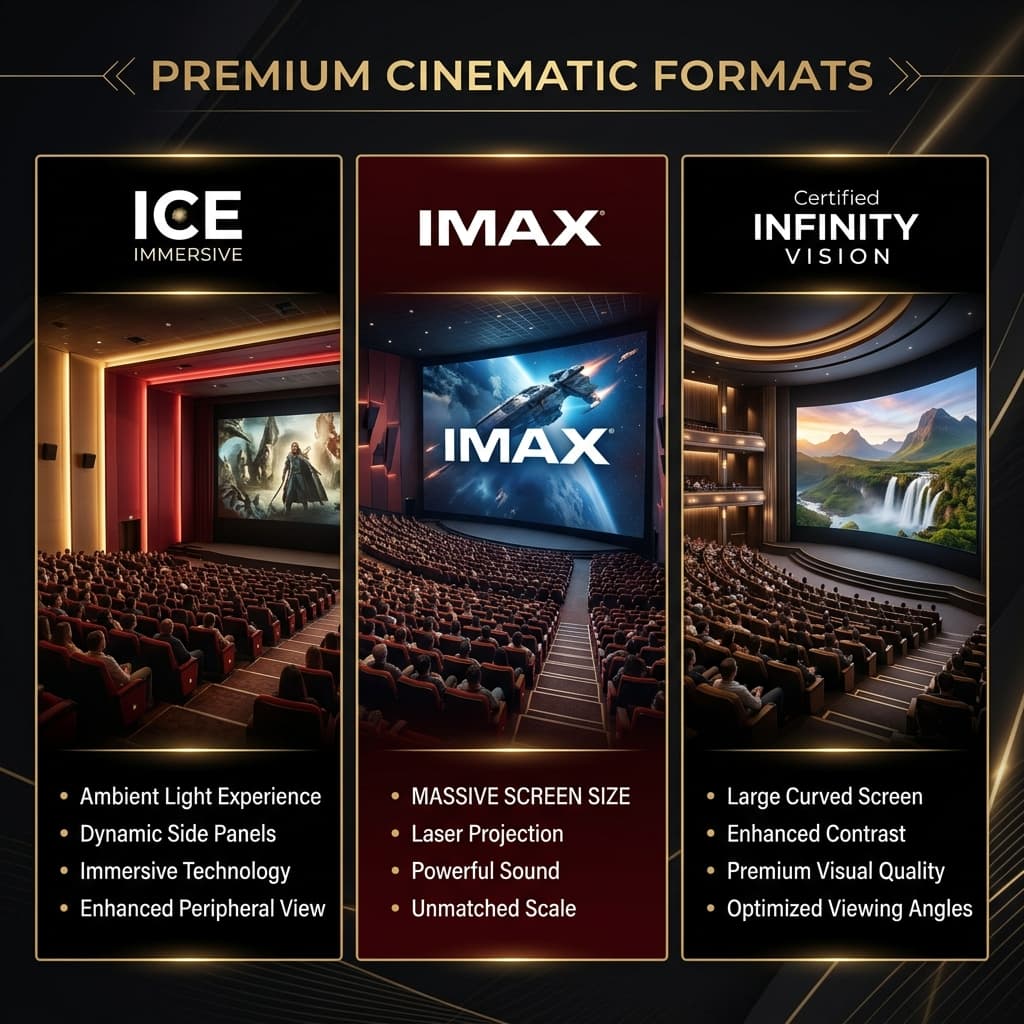
IMAX is for maximum screen scale and immersion. ICE Immersive is for ambient peripheral lighting that extends the picture into the room. Infinity Visionis Disney's certification for large-format laser halls that meet a quality bar for their tentpole releases. Each serves a different purpose, and the best choice depends on what you value most.
Side-by-Side Comparison
| Feature | ICE Immersive | Infinity Vision | IMAX |
|---|---|---|---|
| Type | Premium format | Certification | End-to-end system |
| Developer | CGR / IMERSA | Walt Disney Studios | IMAX Corporation |
| Screen width | ~14 m (46 ft) | ≥15 m (50 ft) | Up to 28 m (90+ ft) |
| Aspect ratio | 2.39:1 | 2.39:1 | 1.43:1 or 1.90:1 |
| Projection | 4K Laser (60k lm) | Laser (certified) | Dual 4K Laser |
| Audio | Dolby Atmos | 7.1+ surround | IMAX 12-channel |
| Special feature | Ambient LED side panels | Disney quality label | Towering screen + bass |
| Best for | Atmosphere lovers | Disney/Marvel fans | Scale seekers |
| India availability | PVR INOX (select) | PLF halls (certified) | PVR INOX, Cinepolis |
Screen & Immersion
IMAX wins on raw screen scale. A true IMAX GT screen can be over 26 metres wide with a tall 1.43:1 aspect ratio that fills your entire peripheral vision, top to bottom. The best IMAX seat delivers a 50-70% horizontal field-of-view fill.
ICE Immersive takes a different approach. Its screen is standard-sized (~14 m), but the ambient LED panels on both walls create a peripheral glow that makes the room feel larger. You are not watching a bigger picture — you are sitting inside a living lightscape that reacts to the movie.
Infinity Visionsits in between. Its ≥50 ft screen requirement ensures meaningful scale, and laser projection guarantees brightness and colour accuracy. But it does not mandate IMAX's tall aspect ratio or ICE's ambient panels.
Audio Comparison
ICE typically pairs with Dolby Atmos 9.1.6, offering precise object-based spatial audio with overhead channels. This is arguable the most refined audio setup of the three.
IMAX uses its proprietary 12-channel system designed for maximum impact. IMAX bass is legendary — chest-thumping low frequencies that you feel physically. Read more in our IMAX vs Dolby Cinema comparison.
Infinity Visionrequires 7.1+ surround, which is good but not as advanced as Atmos or IMAX's bespoke system. The audio quality depends heavily on the specific venue's calibration.
Best Seats Compared
The sweet spot differs slightly for each format:
- ICE Immersive: Centre, rows 5-8. You need balanced coverage from both LED walls. Too far to the side and one wall dominates. Read the full ICE seating guide.
- Infinity Vision: Centre, two-thirds back. Standard large-format rules apply. Read our Infinity Vision guide.
- IMAX: Centre, upper-middle rows (rows 8-11 in most halls). The massive screen needs more distance. Use our distance calculator.
Which Format Should You Choose?
- Choose IMAX for films shot with IMAX cameras (Nolan, Villeneuve, Cameron) or when you want the biggest, most overwhelming screen experience.
- Choose ICE Immersive for visually rich, atmospheric films (sci-fi, fantasy, animation) where the ambient lighting adds another layer of mood and immersion.
- Choose Infinity Vision for Disney and Marvel releases where you want a guaranteed premium experience without paying IMAX prices (where available).
For action-heavy blockbusters, IMAX's scale and bass are hard to beat. For atmospheric films with rich colour palettes, ICE's ambient glow creates a unique experience you cannot get anywhere else.
Compare All Three in CinemaView
CinemaView now includes all three formats in the simulator. Switch between IMAX, ICE Immersive, and Infinity Vision in the viewer to compare screen sizes, hall layouts, and viewing angles from the same seat position. See ICE's ambient LED glow, IMAX's towering screen, and Infinity Vision's large curved screen side by side.